
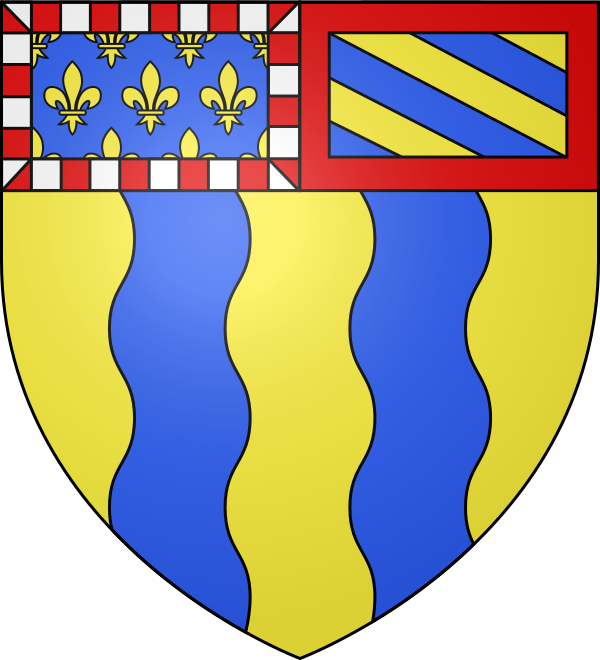
Saône-et-Loire is the department of the Mâconnais and Chalonnais wine regions, the abbeys of Cluny and Tournus, and the museums of arts and crafts in Le Creusot. This vast territory, crossed by the Saône and its tributaries, occupies the southern part of Burgundy and forms a crossroads between north and south, between wine-growing Burgundy and the foothills of the south.
Cluny, whose Benedictine abbey was the largest church in Christendom in the 11th century at 170 metres in length, is a symbol of medieval monastic power. Although largely destroyed during the Revolution, enough remains to imagine the splendour of this complex, which exerted its influence across the entire Christian West. Tournus, whose Abbey Church of Saint-Philibert is one of the masterpieces of Burgundian Romanesque art, the Château de Pierre-de-Bresse with its Museum of Burgundian Bresse, the Château de la Rochepot with its characteristic Burgundian glazed polychrome roofs…
Paray-le-Monial, a major pilgrimage site linked to the apparitions of the Sacred Heart of Jesus to Marguerite-Marie Alacoque, and Le Creusot, the former industrial capital of the Schneider forges, add two unexpected dimensions — spiritual and industrial — to the portrait of a department of remarkable diversity.