
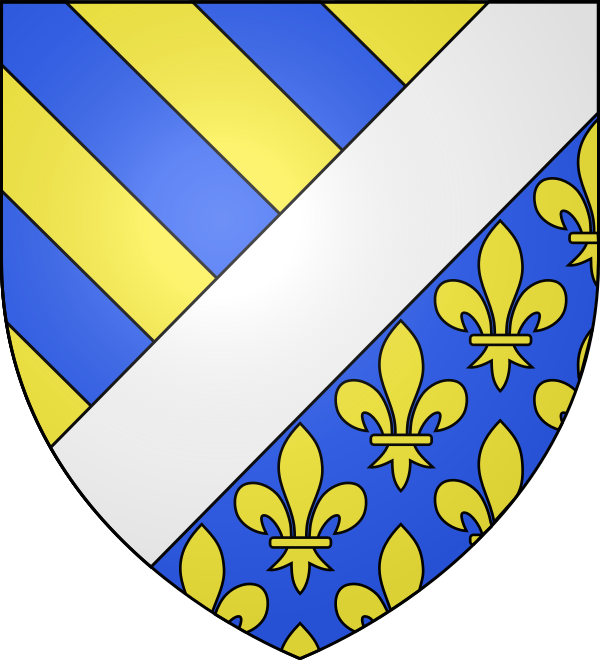
The Oise is the department of southern Picardy and the royal castles, a region of forests and farmland situated on the outskirts of Paris, which for centuries served as a holiday and hunting ground for the kings of France. The Compiègne Forest, one of France’s largest state-owned forests with its 14,500 hectares of oak and beech trees, was the favourite hunting ground of French monarchs from Louis XV to Napoleon III.
Compiègne, whose Neoclassical château—rebuilt by Louis XV and embellished by Napoleon I and Napoleon III—now houses the Second Empire Museum and the Car Museum, is the department’s most iconic monument. It was in the Armistice Clearing, in the Compiègne Forest, that the armistices of 1918 and 1940 were signed, making the department a major site of remembrance for French history. Pierrefonds, a château rebuilt by Viollet-le-Duc for Napoleon III in a spectacular neo-medieval style, Chantilly with its château and the Condé Museum, home to France’s second-largest collection of paintings after the Louvre, Senlis, whose medieval town is one of the best-preserved in northern France…
The Oise is also the department of the Impressionists: Auvers-sur-Oise, where Van Gogh spent the last months of his life and where he is buried alongside his brother Theo, Pontoise and its surroundings, painted by Pissarro and Cézanne, bear witness to the appeal that the landscapes of the Oise held for painters of the late 19th century.