
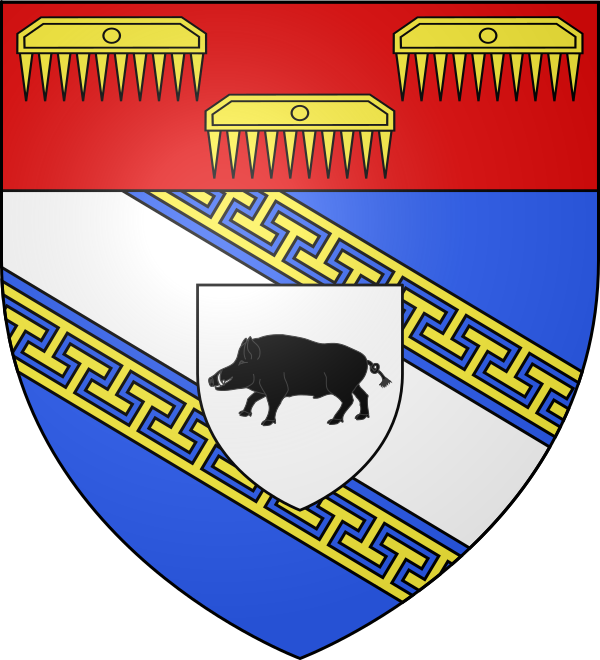
The Ardennes is the department of deep forests and the Meuse, a region of wooded hills, jagged rocks and meandering rivers that forms the natural border with Belgium and was the scene of decisive battles during both world wars. The memory of the Great War and the Second World War is deeply ingrained in this department, whose summer landscapes are deceptively peaceful and verdant.
Sedan, whose fortress — the largest in Europe, covering 35,000 m² — overlooks the Meuse, was the scene in 1870 of Napoleon III’s surrender and in 1940 of the breakthrough by German tanks that opened the route to Paris. This 15th- and 16th-century castle, now a museum, bears witness to the region’s strategic importance for controlling the crossings between France and the German Empire. Charleville-Mézières, the birthplace of Arthur Rimbaud, Monthermé and Les Dames de Meuse, Château-Regnault…
The Meuse Valley, with its meandering river encased between rocky cliffs crowned with medieval ruins, offers one of the most picturesque landscapes in the Ardennes, as depicted by Rimbaud in his early works.